On September 25th 2025, we gathered in Manchester to hear about and get involved in work that is going on in the name of Social Care Future, connect with each other for a more powerful voice and share our ideas to make sure we all do get to live in a place we call home with the people and things that we love.
The day was our usual mixture of thinking and planning together, the chance to work in smaller groups on things that we are passionate about and build our resilience as we work to create a future where we all get to live our Gloriously Ordinary Lives.
There was plenty of singing and dancing (of course!) and we welcomed the incredible choir of the Support and Action for Women’s network (SAWN) to start the day, and the wonderful Leaping Frogs who performed at lunchtime and sent us on our way at the end of the day.
Bryony Shannon did a Manchester launch of her amazing new book, Rewriting Social Care and Karen McCormick from inCharge launched their fabulous new app for families wanting to direct their own support. There was, a public living room set up by the wonder Kathryn Yates from MacIntyre where we got to relax, have a chat and take some time out from the hustle and bustle of the day.
We were thrilled to be joined for the whole day by members of Baroness Louise Casey’s team, and a key focus for the day was what we need to do collectively – as people living in and working in the world of social care alongside central government – to make the Social Care Future vision a reality.
Casey Commission Suggestion Time
We started the day working together to imagine a world where adult social care really is working amazingly well and people are living the lives they choose.
You’ve heard of Question Time. This is Suggestion Time! We pulled together a great panel of “keynote listeners”:
- Daisy Yates from the Casey Commission
- Jess McGregor, President of the Association of Directors of Adult Social Services
- Isaac Samuels, National Co-production Advisory Group for Think Local Act Personal
- Rick Burgess, Greater Manchester Coalition of Disabled People
Instead of the focus being on what the panel think, their job was to really listen and respond to people’s suggestions. They were corralled by our own Andy McCabe, who made a scarily convincing Robin Day! We got into a great debate about what the Casey Commission need to hear if we are going to make social care work for everyone going forward. We started with these three great suggestions:
- From Samantha Clark and Jenny at Learning Disability England: “Our suggestion would be that the Commission ask the government to use its levers on commissioning and procurement to stop the sale of people through on-line bidding and make sure local commissioning is coproduced with people”
- From Rich Amos, National Co-production Advisory Group:“Older and disabled people were one of the first stakeholder groups the commission spoke with. My suggestion would be to have people invited to take up formal positions in both the Commission and Department for Health and Social Care policymaking”
- Sian Lockwood and Angela Catley from When I Get Old: “Investing in a universal good quality creative advice service should be a Government priority”
You can read all the suggestions here and watch Leighton Wise’s amazing film
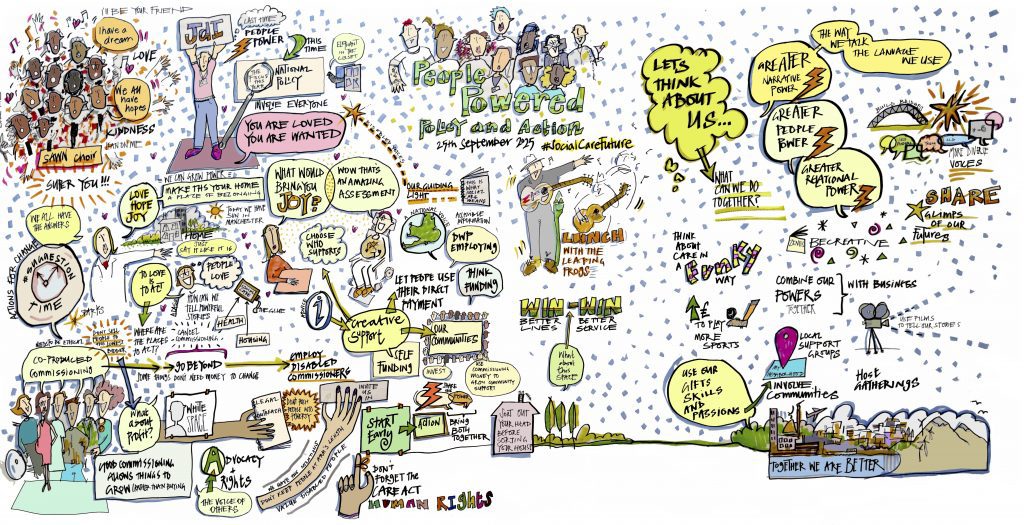
We were also joined by the super-talented Jon Ralph who beautifully captured our ideas in graphic form:
After lunch, we worked in smaller groups, so we all had the chance to take part in something that really matters to us.
Early Action – going for the win-win
Martin Routledge facilitated a session with Matt Skinner and Emily Brook from Care City, Ewan King from Shared Lives Plus and Rose Payne from Newton Europe.
We explored the growing opportunities to shift from crisis or “demand management” to acting early, achieving wellbeing and sustainability. Exciting developments on supporting people to thrive through connections, purpose and relationships, both practical and strategic were shared. Small groups went deeper into the what and how of these initiatives and generated practical proposals for the Casey Commission.
You can download the slides here
Fixing the ‘Plumbing and Wiring’ in adult social care
Andy McCabe and Martin Cattermole led a session on Fixing the “Plumbing and Wiring” in adult social care, which looked at what gets in the way of good support and people being able to lead gloriously ordinary lives, and what work is under way to look for solutions.
We heard from Martin Walker about direct payments, from Sarah Burslem and Aisling Duffy about commissioning, and from Alex Fox about making sure what matters to people drives the information government collects and uses – see slides (ADD LINK). We asked the audience to tell us what change they most wanted, and pulled out messages for the Casey Commission:
- Produce transparent data on outcomes and inequalities that local people can use to hold bodies to account and that will drive change
- Shift the power dynamic back towards people – trust people
- Clearly defined commissioning principles (co-produced, local etc) with clarity on accountability and consequences (Care Quality Commission, Association of Directors of Adult Social Service, Local Government Association)
You can download the slides here
Independent Older Voices
Older people want more options and choices if they need some support from social care. Time and time again surveys tell us what people want but services and systems are struggling to change to reflect this. This workshop was led by Sian Lockwood and Angela Catley from When I Get Old and focused on we can do to get older voices heard and have impact.
We shared what was important as we age, and came up with three keys things that the Casey Commission needs to focus on:
- Provide all older people needing care and support (including self-funders) withgood, local, creative, advice, information and decision-making support
- Ensure that older people have access to amuch wider choice of services and supports than are available currently
- Identify and root out ageism in the commissioning and provision of services for older people
Gloriously Ordinary Language
Too much of the language people use in and about social care reveals and shapes attitudes and ways of working that prevent people from living gloriously ordinary lives. We believe that the language of social care should
be ordinary. What are people starting to do about this. What can we do next? This session was led by Tricia Nicoll and Bryony Shannon and shared the learning from their Gloriously Ordinary Language programme.
The key message for Casey Commission was to keep the language we use in social care real, human and inclusive and stick to the language we use at home around our kitchen table, or at the café or pub with our mates. The session also carried out an exercise exploring how people interpreted the word ‘independence’.
You can see the slides here
You can the results of the exercise on independence here
Reframing adult social care
This interactive session was chaired by Clenton Farquharson from Think Local Act Personal and heard from Sanjiv Lingayah from Reframing Race, Neil Crowther from #SocialCareFuture and Alice Klein from the Association of Directors of Adult Social Services. It began by considering the role of narrative change in pursuing wider system change, and particularly the importance of offering and framing solutions, as well as the shared goals of anti-racism campaigners and those seeking justice for people with reason to draw on adult social care. Neil shared new research insights about how to talk about adult social care to build public understanding and support, developed with Frameworks UK in partnership with Think Local Act Personal, ADASS and the LGA. Alice spoke about the #CareCantWait campaign and encouraged people to share stories of how adult social care supports people to live good lives.
You can read the new research here
Making Co-production more Inclusive – Understanding Anti-Racism and Centring the Voices of Racialised People.
In this interactive session led by the Co-Production Collective we explored what anti-racism really looks like in co-production spaces. We talked honestly about the barriers that racialised individuals face and why it’s so important to centre their voices not just include them on the side lines. Through open conversation, shared experiences and practical reflections we looked at how we can all do better to create more inclusive meaningful and equitable co-production.