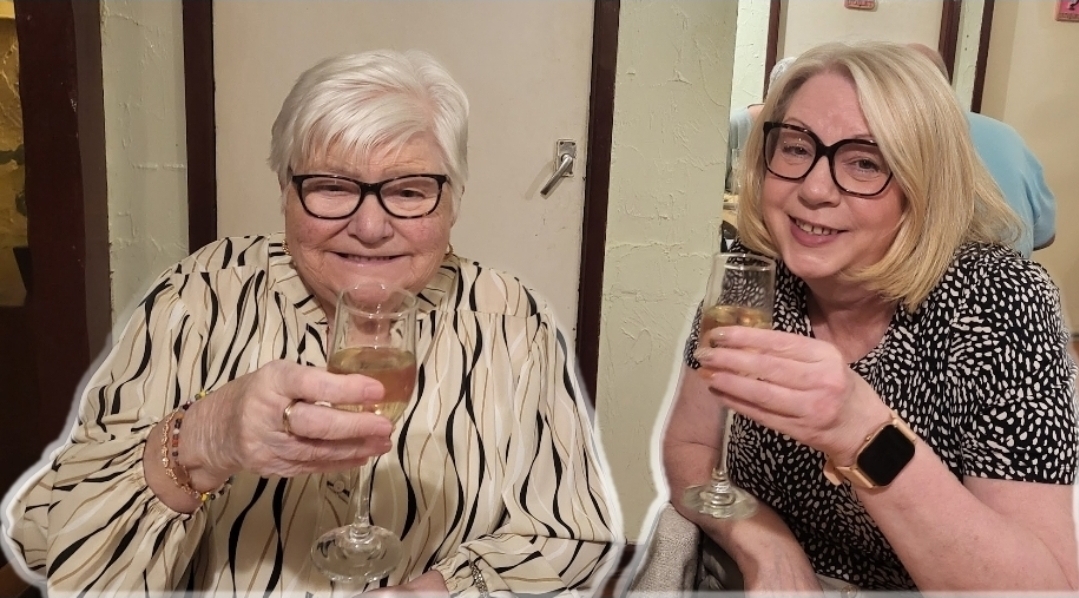
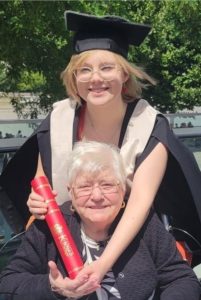
Julie’s daughter Penny on her graduation day, celebrating with her grandma and Julie’s mum Pat
What social care should really make possible…
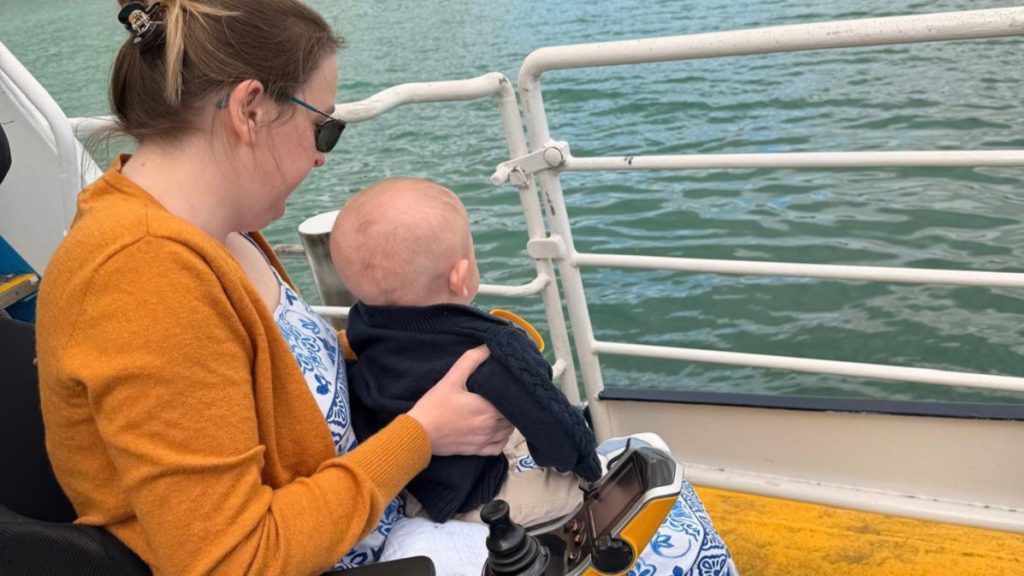
Baroness Campbell’s reflections on a National Care Service are an important contribution to the debate about the future of social care. I support her call for change and the ambition to put people at the heart of a national approach. I am thinking about what that might mean in practice. What it means for Anna Severwright – who relies on social care to support her in being a fantastic mum to her son, to work and to get out with her dog doing what most take for granted – and the millions of people like her.
People need the opportunity to thrive, not simply survive. And that means having real agency in their own support and their own lives.
Having spent many years working in, around and supporting my own family and other folk who draw on Social care alongside my work through In Control, Be Human and as a convenor of Social Care Future, I have seen both the potential of change and the frustration of seeing good ideas become constrained by the very systems they were intended to transform.
We have developed legislation, frameworks, policies, tools and approaches designed to give people greater choice and control. Yet far too many people still find themselves having to fit their lives around services, rather than having support that fits around their lives.
A National Care Service offers an opportunity to change that. But its success should not be measured simply by consistency of provision, access to services or the efficiency of the system. It should be measured by whether people have greater freedom, stronger relationships, meaningful opportunities and the resources to live the lives they choose. And that’s the perspective I and many others across the #SocialCareFuture want to support with when it comes to reform – either through the work of Baroness Louise Casey – or the plans to develop the Prime Minister’s vision for a National Care Service.
Real agency, not simply a choice of services
In Control has long championed self-directed support and the importance of people having genuine control over the support they receive. But we need to recognise the difference between being offered choices within a system and having real agency over your own life.
Agency means having the authority, opportunity and support to make decisions that matter. It means being able to shape who supports you, how that support is provided, when it happens and how it helps you achieve the things that are important to you.
A personal budget without meaningful choice is not self-direction. A personal plan that has been written about someone rather than with them is not person-centred. And a system that expects people to take responsibility without giving them power or resources is not empowering. So perhaps the next chapter of self-directed support needs to be about self-directed lives.
Enabling people to belong, contribute, participate and flourish
Social Care Future has helped us articulate this ambition: We all want to live in the place we call home, with the people and things that we love, in communities where we look out for one another, doing the things that matter to us.
This vision reminds us that social care is not an end in itself. It is part of what enables people to belong, contribute, participate and flourish.
If we want people to thrive, we need to think beyond traditional care services and recognise the importance of relationships, accessible communities, housing, employment, friendships, interests and opportunities to make a contribution.
We also need to challenge the assumption that people who draw on support are primarily recipients of care. They are citizens, neighbours, colleagues, parents, family, friends and more…. people with knowledge, skills and ambitions.
A National Care Service should help make these ordinary opportunities a reality, not inadvertently reinforce the separation between people who receive support and those that provide it.
We can design new structures and funding arrangements, but unless we change the relationships and power dynamics between people and the organisations supporting them, we risk reproducing the same experiences under a different name.
We can show a different way…
There is an opportunity is to work together to turn this ambition into practical change. And that is the offer we are making … bringing people who draw on support, families, practitioners, policymakers, councils and communities together to demonstrate what a different approach looks like. We can share what works, be honest about what doesn’t and help develop practical ways of making choice, control and agency real.
#SocialCareFuture want to help this happen by ensuring the development of a National Care Service can guarantee people have genuine authority over their support; that it can invest in relationships and communities as well as services; and that it can judge success by people’s experiences and opportunities, rather than simply by the activity of the system.
We must also recognise that agency does not mean leaving people to manage alone. People should be able to exercise agency in ways that work for them, with whatever assistance they want and need. The challenge is to move from designing services for people to creating the conditions in which people can direct their own lives.
What social care is for: living a life you want to lead
A National Care Service should be a commitment to enabling people to live well, with dignity, purpose, connection and real control.
We have the vision, the years of learning and practical experience and the people who know what needs to change. Now we need the courage to share power and make that change happen. Because people deserve more than a service that helps them survive. They deserve the agency, support and opportunities to thrive. And the measure of progress should be simple:
Are people gaining more agency, more opportunities, stronger relationships and greater control over the lives they want to lead?
Julie Stansfield is the Chief Executive of the charity In Control and co-convenor of #SocialCareFuture