By Neil Crowther
“Don’t take the temperature, change it” – Anat Shenker-Osorio
Not my priority
Today (2 March 2026), the Kings Fund have published a new report on public attitudes to adult social care called ‘Not my priority’ How the public sees social care (and what can be done about it)’ (link via the button at the end of this post). The report brings together existing public polling data, considers its relationship with media narratives and sector messaging, speculates about its significance and offers some thoughts and conclusions about what this might mean should there be any future efforts to try to address them.
It’s welcome that The Kings Fund have recognised the importance of public thinking and narratives as a key factor shaping the prospects for long term reform, something that #SocialCareFuture has prioritised and carried out extensive work on since our emergence in 2018. Authors Simon Bottery and Dan Welling have produced a useful snapshot of some of the data and insight which exists in the public domain, and pose some challenging questions based on their analysis.
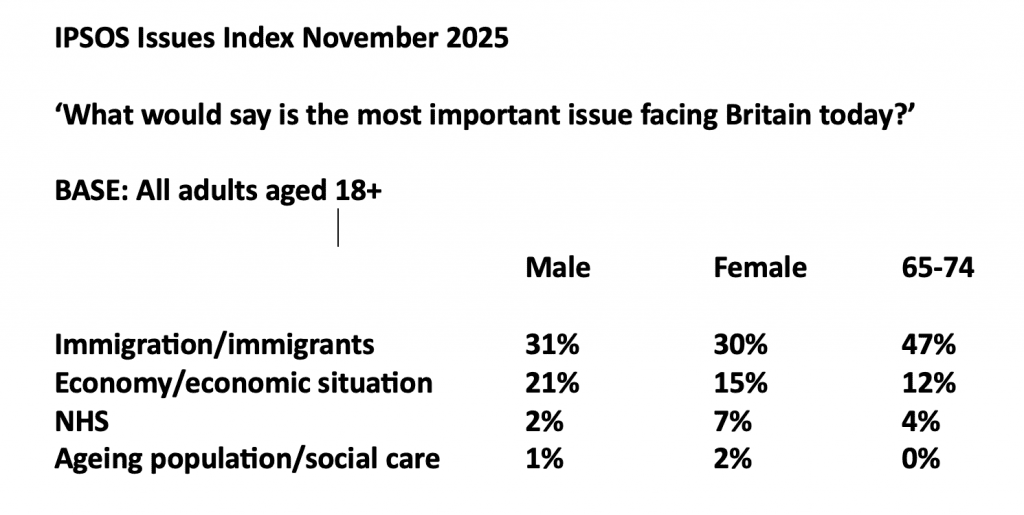
Echoing earlier work, they point to the fact that adult social care appears to enjoy very low public salience, noting how, a few blips aside, it is rarely among the priority issues for the country identified by the public in IPSOS’s bi-monthly, unprompted, ‘issues index’ surveys. They highlight how successive reports have pointed to poor public understanding of what social care is and does, and in particular about how it is funded and which body is responsible for it. And they note how evidence (Survation’s report for #SocialCareFuture) indicates that insofar as the public do have a conception of adult social care, it is one that predates the ‘life not a service’ principles and approaches outlined in the Care Act 2014, centred instead on notions of ‘looking after the vulnerable’.
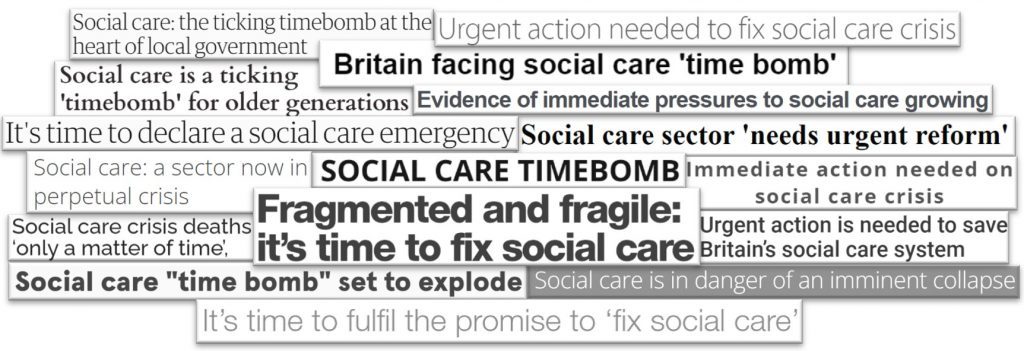
Turning to how the public might form these opinions or understanding, and why social care enjoys low public salience in contrast with the NHS, the authors point to the comparatively low proportion of the public who have any direct experience of drawing on social care. They deduce therefore that those opinions and understanding that the public do have derive either from what they have consumed via the media, or heard from family and friends. They also note that, while some polling shows deep public dissatisfaction with adult social care, it doesn’t appear to translate into public prioritisation. They echo #SocialCareFuture’s warning that a persistent sector and media narrative of a ‘system on the brink’ or in crisis may have over time only served to inculcate fatalism.
The crucial question they then grapple with is how to get the public to care about social care, because if the public doesn’t care, our politicians will never have the political capital to spend on reforming it.
Polling research tells us what people think, not why
It’s surprising that the report hasn’t engaged with a body of work on framing social care and on unpaid caring because, as Kate Stanley, Director of Frameworks UK recently explained ‘rather than focussing on what people think (the focus of polling data), framing research goes deeper and tells us how and why people think as they do.’ That is to say, unlike polling evidence, framing research offers evidence-based insights as to how we can change the story in order to shift understanding and build support for change.
To these ends, The Kings Fund report says that ‘Campaigners need to recognise that the public’s views are rooted in a pre-Care Act understanding of social care. This has important implications for language and messaging, which should recognise where people are rather than where the sector might wish they were.’ This is why #SocialCareFuture embarked on framing research, and the research and guidance we have published over the past 7 years is aimed precisely at addressing this challenge. Meeting people where they are, or simply trying to work around their attitudes, isn’t effective if serving only to confirm the unproductive stories they are carrying in their heads or leaving them where they are. The task is to uncover the opportunities that exist to take them on a different path, and how to avoid triggering ideas that hold more productive thinking back.
Taking people on a journey
#SocialCareFuture research, with Equally Ours, Survation and latterly Frameworks UK, in partnership with the Local Government Association, Association of Directors of Adult Social Services and Think Local Act Personal, has involved extensive qualitative and quantitative research to explore, develop and test messaging capable of shifting mindsets in the direction of the principles and ideas embodied in the Care Act, and away from the default thinking reported by the Kings Fund. Indeed, the research found that, following exposure to a narrative developed through several stages of research and iteration, people assumed an understanding of social care far more closely aligned to the Act, and moreover, having done so there was a statistically significant increase in their expressed prioritisation of adult social care, support for investment and reform, and their optimism about achieving it.
It’s surprising then that the Kings Fund report seems to dismiss the potential of such a story without reference to that evidence, or to any other evidence that suggests otherwise.
It does so by characterising two approaches to pursuing reform as:
“‘Fix’: this approach highlights the crisis in social care and its importance to keeping vulnerable people safe
‘Flourish’: this approach aims to win over the public to investment in a wider model of social care that focuses on people’s wellbeing and potential.”
It argues that:
“the analysis of research in this report suggests that neither of these two main current approaches to social care campaigning will bring about reform by themselves. Calls to ‘fix the social care crisis’ do not appear to impact public prioritisation, even if they may achieve short-term funding gains, and they will struggle to break through ‘social care fatigue’ among the public. However, there is also no evidence that the public prioritises social care sufficiently to pay attention for long enough to take on board messages about it being key to people’s wellbeing, or that they will respond better to abstract concepts like ‘choice’ than to more tangible messages like ‘more people receiving services’.”
But as the report notes, the dominant political, sector and media narrative about adult social care has been, almost without fail ‘fix’ (and often confirming the ‘pre Care Act’ conception of what social care is and does). The so called ‘flourish’ approach has, to date, had little if any chance to be heard, and given the authors conclusion that most awareness and understanding of social care comes from the media, or hearsay, this conclusion cannot really be drawn based on the evidence of public attitudes presented, or by omitting to consider the research evidence which demonstrated its potential. That is to say, if public understanding is largely mediated through the ‘fix’ narrative, then polling results largely reflect only existing narrative exposure, and tell us nothing about the latent values which remain to be tapped. It is these that #SocialCareFuture’s work has identified as holding such potential and around which our narrative and messaging had been crafted to speak to. The authors appear to conclude that if a new frame hasn’t organically emerged in public discourse, it likely lacks political viability. We, and others such as Frameworks UK would argue that if a new frame hasn’t emerged, it may be because it has not been consistently, effectively or engagingly deployed.
However, the lack of consistent, large-scale application and public reach of #SocialCareFuture’s narrative does also mean that we do not know what it’s impact could be on overall salience, on political behaviour and electoral effects, on willingness to support particular policies, including on funding, or its durability over time. We would welcome the opportunity to further test and iterate the narrative based on public audience research to explore these questions, and in particular: “can a ‘flourishing’ narrative expand the coalition willing to accept the case for sustained increases in investment and reform?’
A false dichotomy?
It’s important though to move beyond the analysis about ‘fix’ versus ‘flourishing’ as intrinsically separate and in opposition: as negative versus positive.
If were to say ‘too many people and families are seeing their lives fall apart because they can’t secure the care and support they need to hold them together’ I would be being faithful to the ‘flourishing’ framing and its accent on social care as supporting us being able to live our lives, while emphasising the need for urgent action (both to increase access to social care, and to make sure it was responsive to what people need). And I could tell many powerful stories of what ‘lives falling apart’ means and point to the system failure lying behind it. Or if I tell a story about how ever-tighter local council social care budgets mean that a young woman has been forced to choose between support to go out to see her friends occasionally or to take a shower once a week, I can again promote the ‘flourishing’ frame while bringing into view the shortcomings of adult social care and tapping into people’s sense of unfairness and injustice. While in both cases, framing good practice tells us that we should accompany these problem centred messages with solutions that offer possibility, to avoid feeding the fatalism that the Kings Fund report refers to, it is perfectly possible to align messages of urgency to powerful stories that centre on our right to live ‘gloriously ordinary lives’ and how the system as presently funded and designed is too often failing to.
The truth of the matter is that while the story and language that #SocialCareFuture co-produced has had significant purchase on discourse within the field, those communicators who hold most influence over how social care is reported and talked about in the wider public domain have to date, and for a range of reasons, continued to default to the ‘broken system in crisis’ narrative, without offering a corresponding sense of why the public might have reason to value adult social care. This is especially so when adult social care is most likely to hit the headlines – with a fiscal event or policy announcement on the horizon and when a press release is being drafted or key messages are being given to a spokesperson ahead of a media interview about a new report to say, once again, that the sky is falling in.
Getting people’s attention
And that habit speaks to a very real and important challenge raised by the report: how to win the public’s attention sufficient that we can begin to shift their thinking and secure greater prioritisation. The doom loop we are stuck in, and which the Kings Fund report reflects, is that we almost always start by asking not how to win and maintain the public’s attention, but how to win politicians attention by winning the news media’s attention, offering messages and stories we believe editors, journalists and reporters want, then counting the headlines, opportunities to see and clicks as success. And yet we know – as this evidence confirms – that these are failing to grab or hold the public’s attention and doing little to shift understanding or build the support for change that the politicians need to feel or have behind them to act. In fact, they may well be doing the opposite. Ironically, and despite the weight given to traditional print and broadcast news media by political elites, among the older audiences that continue to engage with such media, and who we might assume to have much more direct interest in adult social care, expressed salience is zero.
That’s why there has to be an intentional effort to shift how news media reports adult social care. Not an easy task, but there are examples to draw on from other fields of social change, including around climate, equal marriage, violence against women, mental health, social security and housing for example. As well as the hard work and discipline of bringing new framing into their own messaging and communications, of iterating and taking risks, campaigners in these fields have directly reached out to and worked with editors, journalists and columnists to explain the rationale for changing the narrative and to support them in doing so.
But we also need to break another habit: seeing traditional news media as the primary vehicle for shifting how people think, feel or act when it comes to social care (or other social change goals). What about all the other things that influence us: lifestyle media, social media, pop culture and the arts, literature, gaming and advertising are all areas that campaigners for change (including colleagues at Caring Across Generations campaigning for better access to social care in the USA) are actively engaged with, and allow us to work beyond the narrow currency of news media. This is not about the short-term strategic communications linked to the fiscal and policy cycles that tend to dictate how social care is communicated about, it’s about mounting a longer-term effort to ‘change the weather.’ Culture change will require resources, organisation, skills, coordination and discipline, of the kind some wealthy organisations in or adjacent to the social care field could marshal the money to make happen.
The law of diminishing returns
On linking adult social care to the NHS the report says:
“Though it will be unpopular in parts of the social care sector, the most obvious way to win public support is to work out how best to link social care to the NHS in messaging. There is evidence that social care is prioritised more when it is seen as being instrumental in improving issues that the public cares about most, particularly the NHS.”
I think it’s undoubtedly true that hospital capacity has driven policy and spending on adult social care over the past ten years, probably more than anything else. The Better Care Fund is testimony to that. But has it driven policy and spending on adult social care beyond questions of hospital capacity? While the Kings Fund report may present one piece of prompted polling evidence to suggest social care’s role in addressing hospital capacity is of concern to the public, this is prioritisation of the NHS, not social care. And we should note that NHS capacity, hospital discharge and ‘bed blocking’ has been a very dominant story for several years, and has had no overall impact on public salience around social care. Given this and the fact that at least 70% of requests for adult social care come from ‘community’ rather than hospitals, this seems unlikely to be the story that builds understanding of the social care system we want or which secures support for the level of investment we need. If NHS linkage increases short term salience, but narrows the case, it may worsen long-term feasibility. Those who regard the praying in aid NHS as the best way to improve the fortunes of adult social care should be mindful of the law of diminishing returns.
This is not to suggest we should not talk about the NHS or health at all, but there are better ways to do it, aligned with the government’s NHS 10-year plan, which emphasis the role of a reformed system of adult social care in supporting people to maintain their health and wellbeing, rather than as a as a pressure valve or outflow for hospitals.
Sell the brownie, not the recipe
There are though countless other things that we all value which adult social care helps us to protect or secure. I couldn’t agree with more when the report says ‘Don’t start with money.’ It’s something we’ve said over and over. Echoing another piece of advice from Anat Shenker-Osorio, we need to sell ‘the brownie, not the recipe’. Before we articulate policies, or talk about funding, we have to answer ‘what’s the life in front of us for ourselves and our families if we make this investment together?’ This was, incidentally, the finding of research by the Nuffield Trust on the experience of countries including Germany and Japan that have gone much further than we have managed to – for people to consider paying more, they need to be convinced there’s something worth paying for. #SocialCareFuture’s research concluded that it was the promise of home, relationships, rootedness, control and having a life to lead (and by dent, the avoidance of losing these things). That’s why our vision begins ‘we all want to live in the place we call home, with the people and things we love…’
Maybe this is something that it would be useful to explore through further public audience research? And then we might consider the most effective ‘tangibles’ to put forward as policy in support of this, such as more people securing some support, people being supported earlier, or a home first package of support to help people avoid moving into a care home.
In conclusion
As the Kings Fund report helpfully and powerfully sets out, how people commonly think about social care now, and what they are largely being told about adult social care, has failed and continues to fail to build support for the ‘system’ imagined in the Care Act or the investment required to sustain it. But low salience may be less about indifference and more about lack of narrative clarity and the failure to tap into latent values. The research and insights we have about framing have yet to be fully tested, but if one dominant narrative hasn’t worked, and evidence points to the clear potential of another, then it surely follows that we should give it a shot before deciding it won’t work, to keep measuring and iterating until we do? It would be great to work with partners to do this, including drawing on learning from other fields who are or have struggled with similar questions.
Ultimately though we need to live by another of Anat’s maxims: ‘a good message doesn’t say what’s popular, a good message makes popular what needs to be said’.